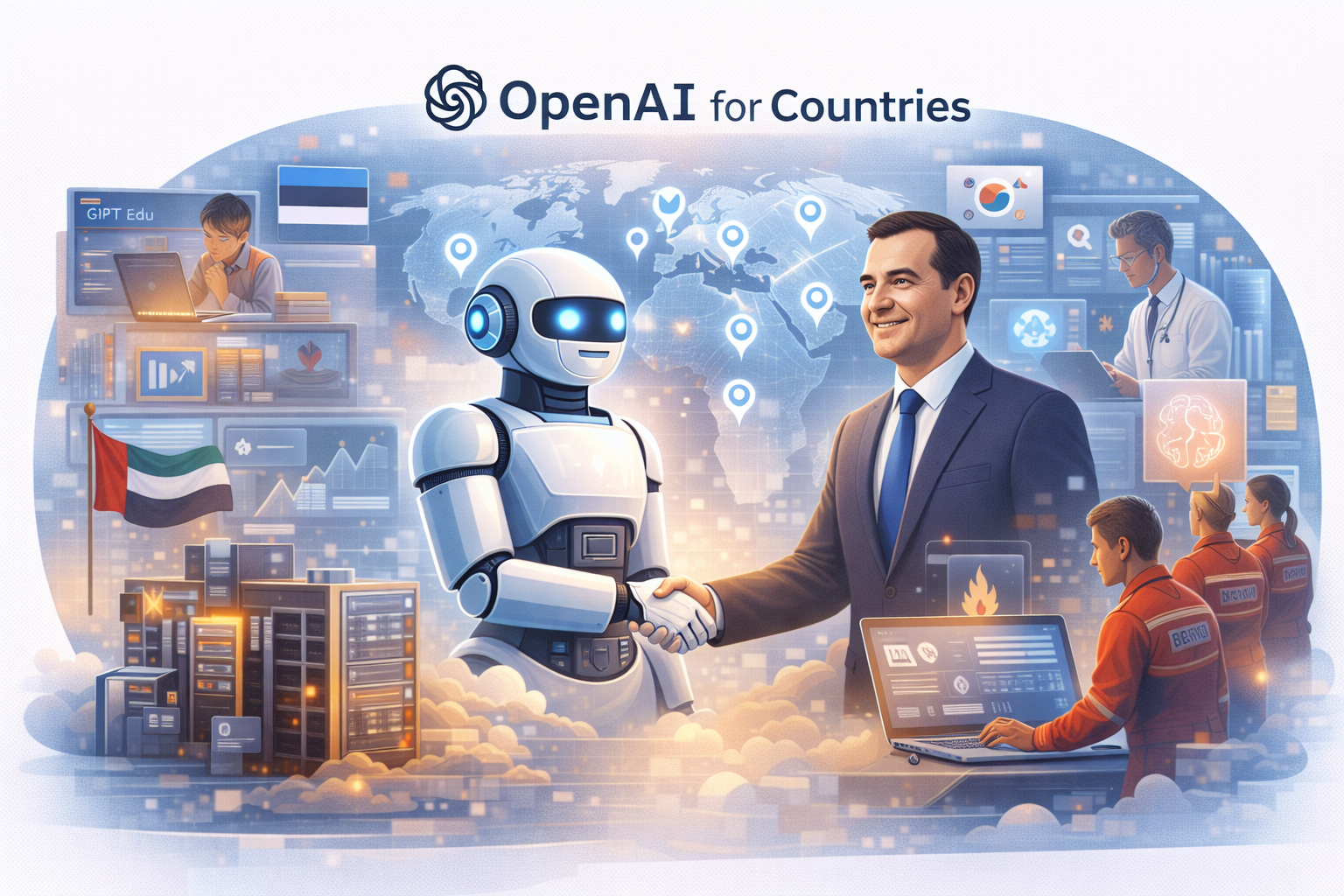
While most AI companies focus on enterprise customers, OpenAI’s “OpenAI for Countries” initiative aims to boost AI adoption worldwide by partnering with governments focusing on practical uses in education, health, and disaster preparedness while urging more data center builds through strategic OpenAI for Countries. This isn’t just market expansion, it’s systematic global AI democratization through governmental channels through comprehensive OpenAI for Countries.
Here’s what separates global AI leaders from global AI followers: while your competitors pursue corporate clients, OpenAI weaponized OpenAI for Countries through program seeking to narrow AI access gap between advanced and developing nations noting that many countries underuse AI’s advanced capabilities through democratizing OpenAI for Countries.
The result? Launched in 2025 with eleven countries joining including Estonia using ChatGPT Edu in schools and UAE pursuing data center collaborations, led by former UK finance minister George Osborne appointed December 2025, proving that OpenAI for Countries doesn’t just sell software, it enables national AI transformation through strategic OpenAI for Countries.
The OpenAI for Countries Revolution That’s Redefining Global AI Access
When AI company valued at $500 billion launches government partnership initiative focused on narrowing access gap between nations, they’re not just pursuing revenue, they’re fundamentally positioning AI as public infrastructure requiring national-level deployment through strategic OpenAI for Countries.
The scope of OpenAI for Countries becomes evident through focusing on practical uses in education, health, and disaster preparedness rather than just commercial applications through purposeful OpenAI for Countries.
OpenAI’s approach to OpenAI for Countries emphasizes deeper integration of tools like ChatGPT into daily government operations beyond experimental pilots through systematic OpenAI for Countries.
The transformation proves that OpenAI for Countries isn’t export strategy but collaborative framework enabling national AI capabilities through comprehensive OpenAI for Countries implementation.
How Government Partnerships Drive OpenAI for Countries Adoption
Most AI companies sell to businesses avoiding government complexity, while OpenAI transformed market approach through OpenAI for Countries partnering directly with governments to enable nationwide adoption through governmental OpenAI for Countries.
The power of government focus in OpenAI for Countries becomes evident through ability to reach entire populations through educational systems and public services rather than individual users through scaled OpenAI for Countries.
Their approach to OpenAI for Countries includes encouraging data center builds providing infrastructure foundation for sustainable national AI capabilities through infrastructural OpenAI for Countries.
When your OpenAI for Countries targets government partnerships, you achieve deployment scale that commercial-only approaches cannot match through national OpenAI for Countries implementation.
The George Osborne Leadership Within OpenAI for Countries
Perhaps the most strategic aspect of OpenAI for Countries is appointing former UK finance minister George Osborne to lead effort in December 2025, bringing governmental expertise through credible OpenAI for Countries.
This leadership choice in OpenAI for Countries demonstrates that government partnerships require leaders who understand policy and international relations rather than just technology through diplomatic OpenAI for Countries.
Osborne’s OpenAI for Countries includes pitching initiative alongside Chris Lehane, OpenAI’s chief global affairs officer, at Davos showing high-level commitment through prominent OpenAI for Countries.
The organizations implementing OpenAI for Countries with former finance minister leadership achieve governmental credibility that pure technology executives lack through credentialed OpenAI for Countries.
The Education Application Focus In OpenAI for Countries
The use case priority within OpenAI for Countries includes education with Estonia using ChatGPT Edu in schools demonstrating practical nationwide deployment through educational OpenAI for Countries.
This education emphasis in OpenAI for Countries demonstrates that schools represent ideal environment for introducing AI to entire generation while providing teachers with productivity tools through generational OpenAI for Countries.
Their OpenAI for Countries approach recognizes that educational AI adoption creates long-term national capabilities by developing AI-literate populations through foundational OpenAI for Countries.
When your OpenAI for Countries prioritizes education, you build sustainable AI capabilities through workforce development rather than just current usage through generational OpenAI for Countries.
The Health and Disaster Preparedness Within OpenAI for Countries
The critical applications of OpenAI for Countries include health and disaster preparedness with South Korea exploring AI for water disaster warnings demonstrating life-saving potential through protective OpenAI for Countries.
This disaster focus in OpenAI for Countries demonstrates that AI addresses urgent public safety needs justifying government investment beyond economic productivity through essential OpenAI for Countries.
Their OpenAI for Countries proves that health and emergency applications create compelling value propositions for government adoption given potential to save lives through vital OpenAI for Countries.
The disaster preparedness application of OpenAI for Countries shows that AI enables better crisis response through predictive capabilities and rapid information processing through protective OpenAI for Countries.
The Data Center Infrastructure Emphasis In OpenAI for Countries
The foundational component of OpenAI for Countries is urging more data center builds with UAE pursuing collaborations demonstrating that sustainable AI requires local infrastructure through infrastructural OpenAI for Countries.
This data center focus in OpenAI for Countries demonstrates that cloud-only approaches create dependencies while local infrastructure enables data sovereignty and sustained capabilities through independent OpenAI for Countries.
Their OpenAI for Countries approach recognizes that governments prefer infrastructure they control rather than complete dependence on foreign cloud services through sovereign OpenAI for Countries.
When your OpenAI for Countries encourages data center investment, you enable sustainable national AI capabilities rather than temporary access through infrastructural OpenAI for Countries.
The Advanced Capability Utilization In OpenAI for Countries
The usage insight from OpenAI for Countries is that power users already leverage reasoning features seven times more than average, showing that advanced capabilities require education through trained OpenAI for Countries.
This utilization gap in OpenAI for Countries demonstrates that providing AI access doesn’t ensure effective usage without training on advanced features like complex reasoning through educated OpenAI for Countries.
Their OpenAI for Countries notes that many countries underuse AI’s advanced capabilities suggesting that deployment must include capability development through comprehensive OpenAI for Countries.
The advanced feature adoption in OpenAI for Countries becomes critical success metric showing whether nations just access basic chat or leverage sophisticated reasoning through capable OpenAI for Countries.
The Eleven Early Adopter Nations Within OpenAI for Countries
The adoption dimension of OpenAI for Countries includes eleven countries joining with Estonia, UAE, and South Korea representing diverse geographic and development contexts through global OpenAI for Countries.
This early adopter diversity in OpenAI for Countries demonstrates that initiative serves both advanced and developing nations rather than limiting to specific regions through inclusive OpenAI for Countries.
Their OpenAI for Countries portfolio spanning education in Estonia, infrastructure in UAE, and disaster warning in South Korea shows versatile application possibilities through diverse OpenAI for Countries.
The eleven-nation adoption of OpenAI for Countries provides proof points and case studies that encourage additional government participation through validated OpenAI for Countries.
The Access Gap Mission Of OpenAI for Countries
The fundamental purpose driving OpenAI for Countries is narrowing AI access gap between advanced and developing nations addressing digital divide concerns through equalizing OpenAI for Countries.
This equity focus in OpenAI for Countries demonstrates that OpenAI positions AI as capability that all nations deserve rather than advantage for wealthy countries alone through democratizing OpenAI for Countries.
Their OpenAI for Countries mission recognizes that AI inequality could worsen global economic disparities making proactive access expansion strategic priority through preventive OpenAI for Countries.
When your OpenAI for Countries explicitly targets access gap, you address concerns about AI concentrating advantages among already-developed nations through equitable OpenAI for Countries.
The Davos Presentation Platform For OpenAI for Countries
The strategic visibility of OpenAI for Countries includes Osborne and Lehane pitching initiative at Davos demonstrating that government AI partnerships warrant attention from global leaders through prominent OpenAI for Countries.
This Davos platform for OpenAI for Countries shows that national AI adoption represents priority topic for international policy discussions through elevated OpenAI for Countries.
Their OpenAI for Countries presentation at World Economic Forum signals that governments increasingly recognize AI as strategic national capability requiring policy attention through validated OpenAI for Countries.
The Davos visibility for OpenAI for Countries creates awareness among government leaders who might otherwise overlook AI transformation opportunities through publicized OpenAI for Countries.
The $500B Valuation Context Of OpenAI for Countries
The commercial backdrop to OpenAI for Countries includes company valued at $500 billion eyeing $1 trillion IPO positioning government partnerships as core to AI leadership through strategic OpenAI for Countries.
This valuation context in OpenAI for Countries demonstrates that government market represents substantial opportunity justifying dedicated initiative and leadership investment through valuable OpenAI for Countries.
Their OpenAI for Countries positioning as core to AI leadership suggests that national partnerships create competitive moat beyond just revenue through strategic OpenAI for Countries.
When your OpenAI for Countries supports $1 trillion valuation ambitions, government market represents critical component beyond enterprise sales through essential OpenAI for Countries.
The Strategic Implementation Lessons From OpenAI for Countries
The OpenAI for Countries initiative provides crucial insights for AI companies considering government markets. First, appoint leaders with governmental expertise like former finance ministers who understand policy contexts through credentialed OpenAI for Countries.
Second, focus on practical high-value applications like education, health, and disaster preparedness that justify government investment through purposeful OpenAI for Countries.
Third, encourage local data center infrastructure enabling sustainable capabilities and addressing sovereignty concerns through infrastructural OpenAI for Countries.
Fourth, provide training on advanced capabilities ensuring that governments utilize sophisticated AI features rather than just basic access through educated OpenAI for Countries.
The Future Belongs To OpenAI for Countries Leaders
Your AI company’s global expansion transformation is approaching through OpenAI for Countries strategies that will define international AI adoption. The question is whether your organization will pursue government partnerships systematically or limit focus to commercial markets.
OpenAI for Countries isn’t just about market expansion, it’s about strategic global positioning that fundamentally changes AI access by partnering with governments to deploy capabilities in education, health, and disaster preparedness through initiatives that narrow gaps between advanced and developing nations while building sustainable infrastructure.
The time for strategic OpenAI for Countries implementation is now as governments recognize AI as national capability priority. The AI companies that systematically pursue government partnerships with appropriate leadership, focus on practical high-value applications, and support local infrastructure will achieve global deployment scale while competitors limit themselves to commercial markets missing governmental opportunities.
The evidence from eleven nations adopting OpenAI for Countries including Estonia’s ChatGPT Edu, UAE’s data centers, and South Korea’s disaster warnings proves that comprehensive government partnerships work when led by credentialed leaders like George Osborne with support from global affairs officers pitching at Davos. The only question remaining is whether your AI company has vision to pursue systematic government partnerships before competitors establish insurmountable positions as preferred national AI providers enabling educational transformation, health improvements, and disaster preparedness through OpenAI for Countries-style initiatives serving populations rather than just corporations.