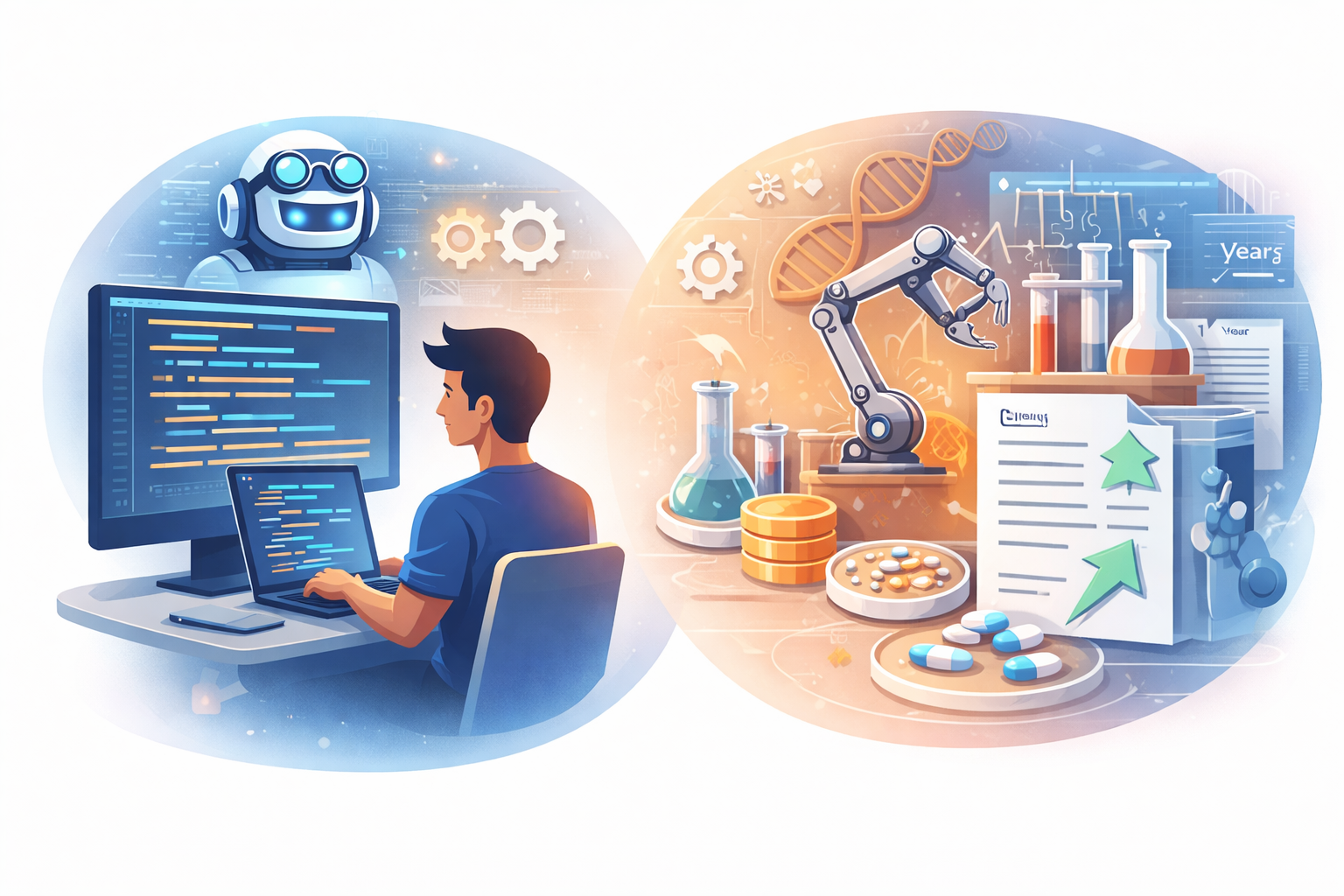
While skeptics question AI’s practical value, early adopters of generative AI coding tools like GitHub Copilot report productivity gains of 26-39% for junior developers with overall task completion rising 26% and specific boosts like 38% more code compilations through measured AI productivity gains. This isn’t just incremental improvement, it’s fundamental transformation of developer workflows and scientific research through comprehensive AI productivity gains.
Here’s what separates AI productivity believers from AI productivity skeptics: while your competitors debate AI value, McKinsey studies show developers completing coding tasks up to twice as fast, refactoring in nearly two-thirds the time, and documentation in half the time through documented AI productivity gains.
The result? Gains extending beyond coding to drug discovery where AI-native platforms cut timelines from 5-6 years to 1 year while materials science sees 44% discovery rate increases and 39% patent output boosts, proving that AI productivity gains don’t just affect software development, they transform scientific research through systematic AI productivity gains.
The AI Productivity Gains Revolution That’s Redefining Developer Efficiency
When early adopters report 26-39% productivity gains for junior developers using generative AI coding tools, they’re not just measuring marginal improvements, they’re fundamentally documenting how artificial intelligence transforms development workflows through strategic AI productivity gains.
The scope of AI productivity gains becomes evident through McKinsey studies showing developers completing tasks up to twice as fast, demonstrating that AI acceleration affects entire development lifecycle through comprehensive AI productivity gains.
Generative AI’s AI productivity gains include 38% more code compilations and 26% overall task completion increases that represent substantial efficiency improvements through measurable AI productivity gains.
The transformation proves that AI productivity gains aren’t theoretical possibilities debated by researchers, they’re practical realities measured by organizations through implemented AI productivity gains.
How Experience Levels Affect AI Productivity Gains In Development
Most productivity technologies benefit all skill levels equally, while AI productivity gains show dramatic variation with junior developers seeing 27-39% output increases but seniors achieving only 8-13% improvements through differentiated AI productivity gains.
The power of this differential in AI productivity gains becomes evident through recognition that AI tools particularly accelerate less-experienced developers who benefit most from code suggestions and examples through amplified AI productivity gains.
Their approach to AI productivity gains demonstrates that automation provides greatest value where knowledge gaps are largest, enabling juniors to perform closer to senior levels through equalizing AI productivity gains.
When your AI productivity gains concentrate among junior developers, you achieve workforce leveling that enables less-experienced staff to contribute more effectively through democratized AI productivity gains.
The Task Complexity Impact On AI Productivity Gains
Perhaps the most important nuance in AI productivity gains is that benefits taper for complex tasks requiring deep architectural thinking where AI suggestions provide less value through task-dependent AI productivity gains.
This complexity limitation in AI productivity gains demonstrates that current AI excels at routine work like auto-filling functions, first-draft code, and updates but struggles with novel problems through capability-constrained AI productivity gains.
AI productivity gains prove strongest for documentation (50% time reduction), moderate for refactoring (33% time reduction), and variable for complex feature development through context-sensitive AI productivity gains.
The organizations understanding AI productivity gains variation by task complexity will deploy tools most effectively by matching AI capabilities to appropriate work through strategic AI productivity gains.
The Quality Considerations Within AI Productivity Gains
The critical validation for AI productivity gains is whether speed comes at quality cost, with evidence suggesting quality holds or improves with iteration though requiring human oversight for bugs and context through maintained AI productivity gains.
This quality dimension of AI productivity gains demonstrates that faster development doesn’t necessarily mean worse code when AI suggestions are properly reviewed through quality-preserving AI productivity gains.
AI productivity gains include enabling “flow state” faster through IDE integration that maintains developer focus while providing suggestions through sustained AI productivity gains.
When your AI productivity gains maintain or improve quality alongside speed, you achieve sustainable acceleration rather than technical debt through quality-assured AI productivity gains.
The Multi-Tool Strategy For AI Productivity Gains
The optimization approach to AI productivity gains shows that using multiple tools yields 1.5-2.5x better results than single tool adoption, demonstrating compound benefits through combined AI productivity gains.
This multi-tool advantage in AI productivity gains suggests that different AI systems have complementary strengths that users can leverage strategically through diversified AI productivity gains.
Their AI productivity gains approach includes developing prompting skills that significantly affect output quality, making human expertise remain critical through skill-dependent AI productivity gains.
The prompting capability for AI productivity gains becomes new skill category where developer effectiveness depends on ability to guide AI effectively through communication-driven AI productivity gains.
The Drug Discovery Transformation Through AI Productivity Gains
The revolutionary extension of AI productivity gains beyond coding is drug discovery where AI-native platforms cut timelines from 5-6 years to 1 year or 18-30 months through accelerated AI productivity gains.
This timeline compression in AI productivity gains demonstrates how AI transforms industries beyond software by accelerating scientific processes that traditionally required years through research-focused AI productivity gains.
Drug discovery AI productivity gains include 40-50% R&D cost reduction by automating screening and predicting failures early, showing both time and cost benefits through efficient AI productivity gains.
When your AI productivity gains reduce drug discovery timelines by 75%, you achieve scientific acceleration that enables addressing diseases faster through transformative AI productivity gains.
The Preclinical Development Acceleration Through AI Productivity Gains
The specific drug development AI productivity gains include 60% faster preclinical readiness with completion in 13 months versus traditional 18-24 months through accelerated AI productivity gains.
This preclinical acceleration through AI productivity gains demonstrates how AI affects not just computational work but entire research workflows including experimental validation through comprehensive AI productivity gains.
Their AI productivity gains approach includes $50-60M savings per drug candidate via predictive filtering and toxicity modeling that prevents wasted effort on likely failures through cost-saving AI productivity gains.
The preclinical AI productivity gains multiply when considering that faster candidate identification enables more attempts within same timeframe through iterative AI productivity gains.
The Materials Science Breakthroughs From AI Productivity Gains
The cross-disciplinary evidence for AI productivity gains includes materials science showing 44% discovery rate increases, 39% patent output boosts, and 40-60% success rate improvements through research-amplifying AI productivity gains.
This materials science acceleration through AI productivity gains demonstrates that AI transforms scientific research across domains, not just software and pharmaceuticals through universal AI productivity gains.
AI productivity gains in materials include shortening R&D cycles 5-10x while improving efficiency 30-50% through generative models designing novel materials faster through optimized AI productivity gains.
When your AI productivity gains affect materials science similarly to coding and drug discovery, you recognize transformation spanning all knowledge work through comprehensive AI productivity gains.
The Property Optimization Through AI Productivity Gains
The materials design dimension of AI productivity gains includes optimizing properties like strength or conductivity with less trial-and-error through generative models that predict performance through intelligent AI productivity gains.
This optimization capability in AI productivity gains demonstrates how AI doesn’t just accelerate existing approaches but enables new research methodologies through novel AI productivity gains.
Materials science AI productivity gains prove that AI can handle complex multi-variable optimization that overwhelms human researchers through computational AI productivity gains.
The property optimization from AI productivity gains creates materials that might never be discovered through traditional trial-and-error approaches through expanded AI productivity gains.
The Workflow Integration Essential For AI Productivity Gains
The implementation factor in AI productivity gains is IDE integration enabling seamless suggestions without workflow disruption that maintains developer focus through integrated AI productivity gains.
This integration requirement for AI productivity gains demonstrates that tool effectiveness depends on fitting naturally into existing workflows rather than requiring context switching through seamless AI productivity gains.
Their AI productivity gains approach includes enabling developers to reach flow state faster by reducing cognitive load through suggestion provision through focus-maintaining AI productivity gains.
When your AI productivity gains come from integrated tools, you achieve adoption rates that separate applications cannot match through workflow-native AI productivity gains.
The Human Oversight Requirement Within AI Productivity Gains
The critical limitation of AI productivity gains is requiring human oversight for bugs and context that AI systems miss, making automation augmentation rather than replacement through supervised AI productivity gains.
This oversight necessity in AI productivity gains demonstrates that current AI cannot fully replace human developers despite substantial productivity improvements through augmenting AI productivity gains.
AI productivity gains prove most valuable when human expertise guides and validates AI output rather than accepting suggestions uncritically through collaborative AI productivity gains.
The human role in AI productivity gains evolves from pure creation to AI guidance and validation, representing skill transformation rather than elimination through transformed AI productivity gains.
The Strategic Implementation Lessons For AI Productivity Gains
The cross-industry AI productivity gains evidence provides crucial insights for organizations considering AI adoption. First, recognize that benefits vary by task complexity with routine work showing highest gains through targeted AI productivity gains.
Second, understand that junior staff gain most from AI tools, enabling workforce leveling that improves team capabilities through democratizing AI productivity gains.
Third, implement multiple AI tools rather than relying on single solution to achieve compound benefits through diversified AI productivity gains.
Fourth, invest in prompting skill development that significantly affects output quality and productivity gains through skilled AI productivity gains.
The Future Belongs To AI Productivity Gains Leaders
Your organization’s efficiency transformation is approaching through AI productivity gains technology that will define competitive advantage across industries. The question is whether your organization will systematically implement AI tools or struggle with traditional workflows.
AI productivity gains aren’t just about technology adoption, they’re about strategic workflow transformation that fundamentally changes how developers code, researchers discover drugs, and scientists design materials through capabilities that deliver measurable acceleration.
The time for strategic AI productivity gains implementation is now. The organizations that act decisively will establish efficiency advantages and innovation velocity that become increasingly difficult for competitors to match as AI productivity gains mature and tool capabilities advance.
The evidence spanning coding, drug discovery, and materials science proves that comprehensive AI productivity gains work across knowledge work domains, delivering 26-39% developer improvements, 75% faster drug timelines, and 44% materials discovery increases. The only question remaining is whether your organization has the vision to implement systematic AI productivity gains before competitors make efficiency their competitive advantage.