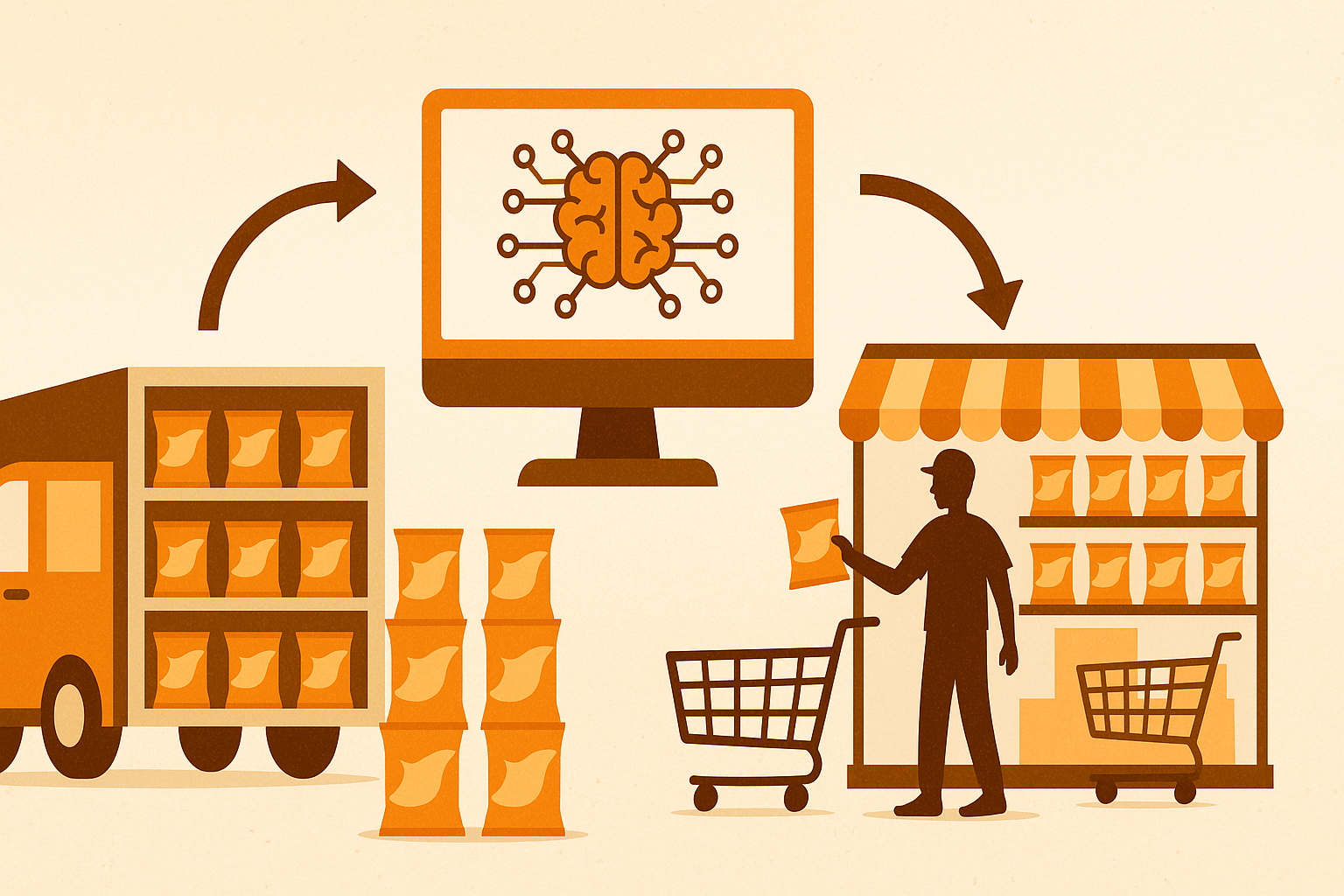
While most FMCG companies struggle with stock-outs and excess inventory, PepsiCo employs AI to forecast snack demand by analyzing vast datasets including weather, social media trends, local events, historical sales, seasonality, pricing, and customer behavior that enable precise stocking and supply chain optimization through strategic AI demand forecasting. This isn’t just inventory management, it’s complete transformation of distribution economics through comprehensive AI demand forecasting.
Here’s what separates supply chain winners from supply chain losers: while your competitors rely on historical averages and manual adjustments, PepsiCo weaponized AI demand forecasting through machine learning models that predict daily snack demand at individual sales points with 98% accuracy for 86% of products through systematic AI demand forecasting.
The result? Reduced truck stock-out rates by 4%, increased average order size by 3.1%, and boosted average SKUs per order by 16% while optimizing truck loading for thousands of drivers and sales reps, proving that AI demand forecasting doesn’t just prevent stock-outs, it fundamentally transforms distribution profitability through strategic AI demand forecasting.
The AI Demand Forecasting Revolution That’s Redefining FMCG Distribution
When a consumer goods leader like PepsiCo partners with TAZI AI to deploy machine learning models that predict demand at individual sales points, they’re not just improving forecasts, they’re fundamentally transforming how FMCG companies approach distribution and inventory management through strategic AI demand forecasting.
PepsiCo’s approach to AI demand forecasting focuses on analyzing multiple data sources simultaneously including weather patterns, social media trends, local events, and customer behavior rather than relying on sales history alone through comprehensive AI demand forecasting.
Their success with AI demand forecasting demonstrates how addressing challenges like sales rep turnover and demand fluctuations requires sophisticated models that build corporate memory of sales trends through institutional AI demand forecasting.
The transformation proves that AI demand forecasting isn’t just about prediction accuracy, it’s about creating systematic intelligence that optimizes entire distribution operations through comprehensive AI demand forecasting implementation.
How Smart Companies Turn Multiple Data Sources Into Distribution Advantage Through AI Demand Forecasting
Most FMCG companies analyze sales history in isolation, while PepsiCo transformed diverse data streams into forecasting advantage through AI demand forecasting that integrates weather, social media, events, seasonality, and pricing simultaneously.
The power of PepsiCo’s AI demand forecasting becomes evident through 98% accuracy achieved for 86% of products by considering factors that traditional forecasting ignores through sophisticated AI demand forecasting.
Their approach to AI demand forecasting includes real-time analysis of emerging trends like social media buzz or weather changes that enable proactive adjustments before demand shifts through responsive AI demand forecasting.
When your AI demand forecasting can integrate multiple data sources while maintaining individual product-level accuracy, you achieve prediction precision that traditional methods cannot match through comprehensive AI demand forecasting implementation.
The Individual Sales Point Prediction That AI Demand Forecasting Enables
Perhaps the most significant breakthrough in PepsiCo’s AI demand forecasting is predicting daily demand at individual sales points rather than aggregated regional forecasts through granular AI demand forecasting.
This granularity through AI demand forecasting fundamentally changes distribution efficiency by enabling precise truck loading that matches specific store needs rather than generic inventory mixes through targeted AI demand forecasting.
PepsiCo’s AI demand forecasting demonstrates how individual point prediction prevents both stock-outs at high-demand locations and overstock at low-demand points through optimized AI demand forecasting.
The organizations that implement granular AI demand forecasting will dominate distribution efficiency while competitors struggle with aggregated forecasts that create waste through imprecise AI demand forecasting.
The Stock-Out Reduction That AI Demand Forecasting Delivers
The most critical business metric from PepsiCo’s AI demand forecasting is 4% reduction in truck stock-out rates that directly impacts revenue by preventing lost sales through availability-focused AI demand forecasting.
This stock-out improvement through AI demand forecasting represents substantial revenue recovery when applied across thousands of distribution routes and millions of sales transactions through systematic AI demand forecasting.
Their AI demand forecasting approach ensures that high-demand products are always available while preventing excess inventory of slow-moving items through balanced AI demand forecasting.
When your AI demand forecasting can reduce stock-outs while minimizing overstock simultaneously, you achieve inventory optimization that improves both revenue and profitability through efficient AI demand forecasting.
The Order Optimization That AI Demand Forecasting Creates
PepsiCo’s AI demand forecasting increased average order size by 3.1% and boosted average SKUs per order by 16%, demonstrating how accurate prediction enables better product mix through optimized AI demand forecasting.
This order optimization through AI demand forecasting improves distribution economics by maximizing revenue per delivery stop while ensuring product variety that drives impulse purchases through strategic AI demand forecasting.
Their AI demand forecasting demonstrates how prediction accuracy enables sales reps to carry optimal product mix that matches specific customer needs through intelligent AI demand forecasting.
The order improvements from AI demand forecasting compound profitability by increasing revenue per route while reducing delivery frequency requirements through efficient AI demand forecasting.
The Truck Loading Optimization That AI Demand Forecasting Enables
The operational transformation from PepsiCo’s AI demand forecasting includes optimizing truck loading for thousands of drivers and sales reps based on predicted demand rather than generic inventory standards through precision AI demand forecasting.
This loading optimization through AI demand forecasting prevents wasted truck capacity while ensuring availability of high-demand products through space-efficient AI demand forecasting.
PepsiCo’s AI demand forecasting enables dynamic loading plans that adapt to daily conditions rather than following static patterns that ignore demand variations through flexible AI demand forecasting.
When your AI demand forecasting can optimize truck loading at scale across thousands of routes, you achieve distribution efficiency that manual planning cannot match through systematic AI demand forecasting.
The Event-Based Forecasting That AI Demand Forecasting Provides
PepsiCo’s broader AI demand forecasting efforts with partners like AWS and Salesforce include demand sensing during events like Super Bowl weekends or heatwaves that create temporary demand spikes through event-aware AI demand forecasting.
This event integration in AI demand forecasting prevents stock-outs during high-demand periods while avoiding overstock after events end through contextual AI demand forecasting.
Their AI demand forecasting demonstrates how understanding event impact enables proactive inventory positioning that captures sales opportunities competitors miss through anticipatory AI demand forecasting.
The event-based capabilities of AI demand forecasting become increasingly valuable as companies recognize that standard forecasts miss significant demand variations through context-aware AI demand forecasting.
The Corporate Memory That AI Demand Forecasting Builds
The institutional benefit of PepsiCo’s AI demand forecasting is building corporate memory of sales trends that survives sales rep turnover and organizational changes through knowledge-preserving AI demand forecasting.
This memory function through AI demand forecasting ensures that accumulated market intelligence remains accessible rather than leaving with departing employees through institutional AI demand forecasting.
PepsiCo’s AI demand forecasting proves that systematic knowledge capture creates lasting competitive advantages that compound over time through learning AI demand forecasting.
When your AI demand forecasting builds institutional memory, you achieve continuous improvement that manual systems cannot sustain through knowledge-retaining AI demand forecasting.
The Waste Reduction That AI Demand Forecasting Achieves
PepsiCo’s AI demand forecasting minimizes waste by preventing overproduction and overstocking that create spoilage and markdown losses through precision AI demand forecasting.
This waste reduction through AI demand forecasting improves profitability while supporting sustainability goals by reducing environmental impact of excess production through efficient AI demand forecasting.
Their AI demand forecasting demonstrates how accurate prediction enables lean operations that produce and distribute only what markets will consume through optimized AI demand forecasting.
The waste prevention from AI demand forecasting creates both economic and environmental benefits that strengthen brand reputation through responsible AI demand forecasting.
The Revenue Recovery That AI Demand Forecasting Enables
The financial impact of PepsiCo’s AI demand forecasting includes recovering billions in lost sales by preventing stock-outs and optimizing product availability through revenue-focused AI demand forecasting.
This revenue recovery through AI demand forecasting demonstrates how prediction accuracy directly translates to top-line growth by capturing sales that inadequate inventory would miss through availability-ensuring AI demand forecasting.
PepsiCo’s AI demand forecasting proves that distribution optimization creates revenue opportunities beyond just cost reduction through growth-enabling AI demand forecasting.
When your AI demand forecasting can recover billions in lost sales, the technology investment ROI becomes immediately clear through revenue-generating AI demand forecasting.
The Partnership Strategy That Amplifies AI Demand Forecasting
PepsiCo’s AI demand forecasting includes partnerships with TAZI AI, AWS, and Salesforce that provide specialized capabilities rather than building everything internally through collaborative AI demand forecasting.
This partnership approach to AI demand forecasting enables access to leading-edge technologies while focusing internal resources on business-specific applications through strategic AI demand forecasting.
Their AI demand forecasting demonstrates how successful AI implementation often requires ecosystem partnerships that combine specialized expertise through integrated AI demand forecasting.
The partnership benefits of AI demand forecasting compound over time as technology providers continuously improve platforms that all partners leverage through collaborative AI demand forecasting.
The Strategic Implementation Lessons That Define AI Demand Forecasting Success
PepsiCo’s AI demand forecasting transformation provides crucial insights for FMCG companies considering predictive analytics. First, integrate multiple data sources including weather, social media, and events beyond just sales history through comprehensive AI demand forecasting.
Second, implement prediction at individual sales point level rather than aggregated forecasts that hide important variations through granular AI demand forecasting.
Third, optimize entire distribution operations including truck loading and product mix rather than just forecasting through holistic AI demand forecasting.
Fourth, build partnerships with specialized AI providers that accelerate capability development through collaborative AI demand forecasting.
The Future Belongs To AI Demand Forecasting Leaders
Your FMCG organization’s distribution transformation is approaching through AI demand forecasting technology that will define competitive advantage for companies willing to invest in predictive intelligence. The question is whether your company will develop comprehensive AI demand forecasting capabilities or struggle with stock-outs and waste.
AI demand forecasting isn’t about technology alone, it’s about strategic distribution transformation that fundamentally changes how FMCG companies understand demand, optimize inventory, and serve customers through capabilities that multiply profitability.
The time for strategic AI demand forecasting implementation is now. The organizations that act decisively will establish distribution efficiency and availability that become increasingly difficult for competitors to match as AI demand forecasting capabilities mature and market expectations evolve.
PepsiCo proved that comprehensive AI demand forecasting works at massive scale while delivering measurable business benefits including reduced stock-outs, increased order sizes, and billions in recovered revenue. The only question remaining is whether your executive team has the vision to implement systematic AI demand forecasting before competitors make it their advantage in FMCG distribution and profitability.